Authentication Capacity Anxiety
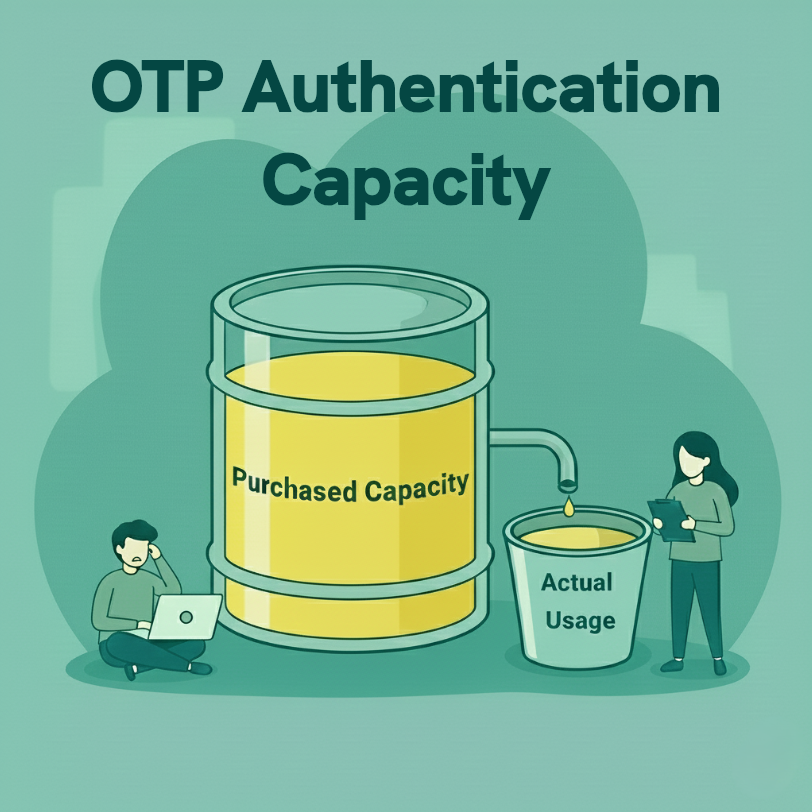
TL;DR: Startups and small businesses frequently fall into the authentication capacity anxiety trap – buying 2-3x their actual needs or under-purchasing and scrambling when capacity runs critically low. This behaviour stems from service interruption fear and purchasing habits inherited from providers with rigid expiration models. The result: capital locked in unused authentication credits that could have funded marketing campaigns, product development, or operational buffers – the very growth initiatives the authentication capacity was meant to support.
The Financial Discovery That Doesn’t Add Up
End of quarter review. Finance pulls the authentication usage report. The business purchased capacity for 15,000 monthly authentications. Actual usage: 12,200. The gap: 2,800 unused authentications, representing £1,000 locked in credits that will expire before consumption.
This scenario isn’t isolated. Capacity planning challenges – manifesting as either defensive over-purchasing or risky under-purchasing – occur systematically across startups and small businesses, creating a silent drain on budgets that can ill afford the waste. Yet the pattern persists, quarter after quarter, provider after provider.
The question becomes unavoidable: why does this keep happening?
Understanding the Authentication Capacity Anxiety Pattern
What’s Actually Happening
Startups consistently purchase authentication capacity at 2-3x their actual needs – or the opposite, under-purchasing and scrambling at critical moments. Two primary forces drive this authentication capacity anxiety: legitimate service interruption fear combined with absence of historical usage data. The defensive logic sounds reasonable: “Better to have too much capacity than risk running out during a critical campaign.”
However, this seemingly prudent approach creates its own set of problems. Authentication capacity anxiety doesn’t just waste money – it actively redirects capital away from the activities that drive actual business growth.
The Financial Impact of Capacity Anxiety on Startup Budgets
Authentication capacity planning hits small businesses differently than enterprises. The financial vulnerability stems from three compounding factors: capital constraints, pricing structure disadvantages, and opportunity cost multiplication.
Small businesses typically operate with monthly budgets measured in hundreds or low thousands of pounds. Authentication capacity purchases compete directly with other critical investments – hiring, marketing spend, infrastructure upgrades, emergency reserves. When £1,000-£2,000 gets allocated to unused capacity, that capital doesn’t disappear as waste – it actively prevents other investments from occurring.
The pricing structure amplifies this impact. Enterprise clients negotiate volume discounts and flexible payment terms. A £10,000 over-purchase for an enterprise with £50,000 monthly authentication spend might represent acceptable variance. The same £2,000 over-purchase for a small business represents their entire operational budget – the difference between launching a marketing campaign or postponing growth entirely.
Opportunity cost multiplication occurs when purchase timing intersects with business growth cycles. Authentication capacity purchased in January to support projected Q1 acquisition can consume the marketing budget meant for February campaigns. By Q2, market windows may have closed. The unused capacity didn’t just waste money – it altered the business trajectory.
Why Traditional Authentication Models Create Capacity Planning Pressure
The Root Cause: Model Design Creates Purchasing Decisions Under Uncertainty
Traditional authentication providers operate on varying billing cycles – monthly subscriptions, quarterly packages, or annual contracts. Regardless of timeframe, credits expire, creating “use it or lose it” psychology that drives defensive purchasing. The model itself generates the dilemma: purchase too much and waste money, or purchase too little and risk service interruption during critical growth periods. Most choose over-purchasing as the lesser evil.
The pressure doesn’t disappear when businesses switch between models – it shifts form. Monthly subscriptions create constant renewal pressure and short planning horizons. Annual packages reduce frequency but amplify miscalculation stakes. Base-fee-plus-overages promise flexibility but introduce unpredictable costs when usage spikes. Volume-tiered pricing creates pressure to reach the next tier threshold, sometimes leading businesses to over-purchase to qualify for rates they don’t benefit from at their current scale. Each model addresses certain pain points whilst introducing others. The underlying uncertainty about capacity needs persists regardless of packaging structure.
Inherited Purchasing Habits Persist Across Providers
Switching authentication providers doesn’t reset purchasing psychology. Businesses migrating from providers with rigid expiration models bring established capacity planning behaviours with them. Defensive purchasing patterns developed under previous constraints remain active even when the new provider operates under different terms.
This persistence occurs because the concern driving the behaviour hasn’t changed, only the provider. A business that learned to over-purchase capacity by 40% “for safety” often replicates this pattern with their new provider. The purchasing decision reflects learned patterns rather than current reality – muscle memory applied to capacity planning.
Calculation Without Historical Data
The absence of usage history creates a fundamental estimation problem for new businesses. Authentication capacity planning requires forecasting future volumes, but newly launched services possess no demonstrated patterns. This vacuum gets filled by financial projection models – spreadsheet exercises showing optimistic user acquisition curves.
A typical projection follows an optimistic trajectory: A SaaS platform launching in Q1 might project 500 authentications in month one, scaling to 5,000 by month six. Growth buffers then get applied – often 30-50% additional capacity “for safety” – transforming the 5,000 monthly projection into a 7,500 capacity purchase.
Then operational reality begins. Month six reaches 1,400 monthly authentications – sustainable, profitable growth with strong unit economics. Yet the business purchased capacity anticipating 7,500. The gap between projection and reality creates massive over-purchased capacity that won’t get consumed before expiration.
Industry Responses: Alternative Models and Their Trade-offs
Recognising these capacity planning challenges, providers have developed alternative pricing models. The most prominent response: pay-as-you-go pricing.
Pay-as-you-go eliminates capacity planning entirely. Businesses consume authentication services without upfront capacity decisions, paying only for actual usage. No defensive over-purchasing. No risk of running out. No expired credits. However, pay-as-you-go models bill after usage occurs, creating dependencies on payment infrastructure functioning correctly. Payment method expiration, processor service interruptions, or banking system issues that would normally delay billing instead trigger immediate service suspension. Unlike prepaid models where purchased credits provide operational buffer, pay-as-you-go offers no such cushion. Capacity concerns shift to payment infrastructure concerns – different manifestation, similar stress.
Another common response: tiered subscription models with automatic overages. These provide baseline capacity with flexibility for spikes. However, the capacity planning problem splits into two decisions. Businesses must still estimate which tier matches their baseline needs (recreating the original estimation challenge), whilst remaining uncertain whether actual usage will exceed that tier and trigger overage charges. A business selecting the 10,000 monthly authentication tier might discover their actual pattern sits at 8,500 authentications – still representing 15% over-purchase. The planning problem hasn’t disappeared – it’s been constrained within tier boundaries rather than eliminated.
Each model addresses specific pain points whilst introducing others. The capacity planning problem persists, simply manifesting differently depending on which structural trade-offs the business accepts.
How Akedly Addresses Authentication Capacity Planning Challenges
At Akedly, we redesigned authentication capacity management to address the model design issues and planning challenges that create purchasing pressure across the industry.
Extended Credit Lifespan Eliminates Expiration Pressure
Year-long credit lifespan replaces monthly or quarterly cycles. This fundamental change eliminates “use it or lose it” deadlines that drive defensive over-purchasing. Businesses can purchase based on demonstrated needs rather than worst-case scenarios. Capital allocation follows business needs rather than provider billing cycles. Conservative initial purchases become viable – monitor real patterns over months, then top up as actual growth materialises rather than projected growth that might never arrive.
Additionally, prepaid credits provide operational continuity during payment complications. Card expiration, processor issues, or banking delays don’t trigger immediate service suspension. Authentication continues operating whilst payment infrastructure problems get resolved – eliminating the payment continuity vulnerability that pay-as-you-go models introduce.
Intelligent Calculator Prevents Wasteful Purchases Before Commitment
The capacity calculator shows all available packages with transparent per-message rates. The key difference: the system actively warns against wasteful purchases before money gets committed. The calculator flags packages that far exceed 12-month usage projections, showing exactly how much would expire unused. Warnings display precise waste calculations – steering businesses towards right-sized purchases based on realistic usage rather than defensive over-buying driven by service interruption fears or purchasing habits inherited from previous providers.
Monitoring Tools Transform Guesswork Into Data-Driven Planning
The dashboard provides real-time visibility into authentication usage patterns, trends, and consumption velocity through the capacity cycle. Businesses can track daily, weekly, and monthly usage volumes, monitor whether consumption patterns are accelerating or remaining steady, and understand precisely how much capacity remains. This visibility transforms capacity management from projection-based guesswork into data-driven planning.
The milestone alert system sends notifications at 25%, 50%, 75%, and 90% usage thresholds. These alerts confirm what dashboard data already shows – functioning as a safety net ensuring nothing escapes attention during busy operational periods. Together, dashboard visibility and milestone alerts enable proactive top-up planning rather than reactive scrambling when capacity runs critically low.
Expert Guidance Throughout the Capacity Planning Process
Expert consultation remains available throughout capacity planning – not as conditional support requiring escalation, but as standard service integrated into every purchase decision. This consultation helps businesses distinguish between actual capacity needs and projected aspirations, ensuring purchases align with demonstrated usage patterns rather than defensive over-buying or purchasing habits inherited from previous providers operating under different credit models.
The Business Result
Predictable authentication costs based on actual usage rather than defensive projections. Service continuity guaranteed until credits deplete – payment complications don’t trigger immediate downtime. Capital available for activities that actually drive growth – marketing campaigns, product development, customer success initiatives. Operational calm replacing purchasing pressure and crisis-driven capacity decisions.
Most importantly, authentication capacity supporting business operations rather than draining budgets meant for growth initiatives. The three compounding factors affecting small businesses – capital constraints, pricing structure disadvantages, and opportunity cost multiplication – get addressed through extended credit validity, transparent pricing that actively prevents waste, and prepaid buffers that protect business continuity during the optimal timing windows for growth activities.
Conclusion
Authentication capacity planning challenges stem from a combination of industry model design and the inherent difficulties of forecasting without historical data. Short expiration windows create purchasing pressure. That pressure drives defensive over-buying or risky under-purchasing. Alternative models like pay-as-you-go or tiered subscriptions address certain pain points whilst introducing others – the underlying planning challenge persists, simply manifesting differently.
A better approach exists: extended credit lifespans that eliminate purchasing pressure, intelligent calculators that actively flag wasteful purchases before commitment, monitoring tools that provide visibility, prepaid buffers that ensure service continuity during payment complications, and expert guidance ensuring capacity matches genuine needs rather than learned patterns from previous providers.
Authentication capacity should support business growth, not prevent it by draining the budget needed to pursue that growth.
Try Our Tools!
💬 Use our calculator to right-size your authentication capacity!